Studio Foreword
Wave Animation is a hand-drawn 2D studio. Our production standard — frames drawn by people, one at a time — is the slowest and most expensive way to make an animated film. In 2026 it is also, at a glance, one of the easiest things in the world to imitate. A generative model can return something that reads as animation in the time it takes an assistant animator to sharpen a pencil.
So the question this paper set out to answer was commercial, not moral. If a machine can produce a competent image in seconds, what is a drawn frame actually worth? The answer the evidence points to is that the value has moved. It is moving off the finished image and onto the thing behind it: who made this, how, and can that be shown. Abundance has not destroyed scarcity — it has relocated it.
That conclusion has direct consequences for how a studio like ours should be built. It argues for documenting authorship as a condition of production rather than as marketing. It argues that cultural specificity is a commercial asset and not only a cultural one. It argues that craft training is infrastructure. Section 9 sets out how Wave reads its own position against the evidence, including what the evidence does not support.
We are publishing this openly because the finding is not proprietary. Jamaica's animation sector is small enough that no studio here wins by keeping a market read to itself. If this paper is useful to another studio, a training institution, or the National Animation Policy consultation, it has done its job.
— The Wave Animation Executive Writers Club
Central Thesis
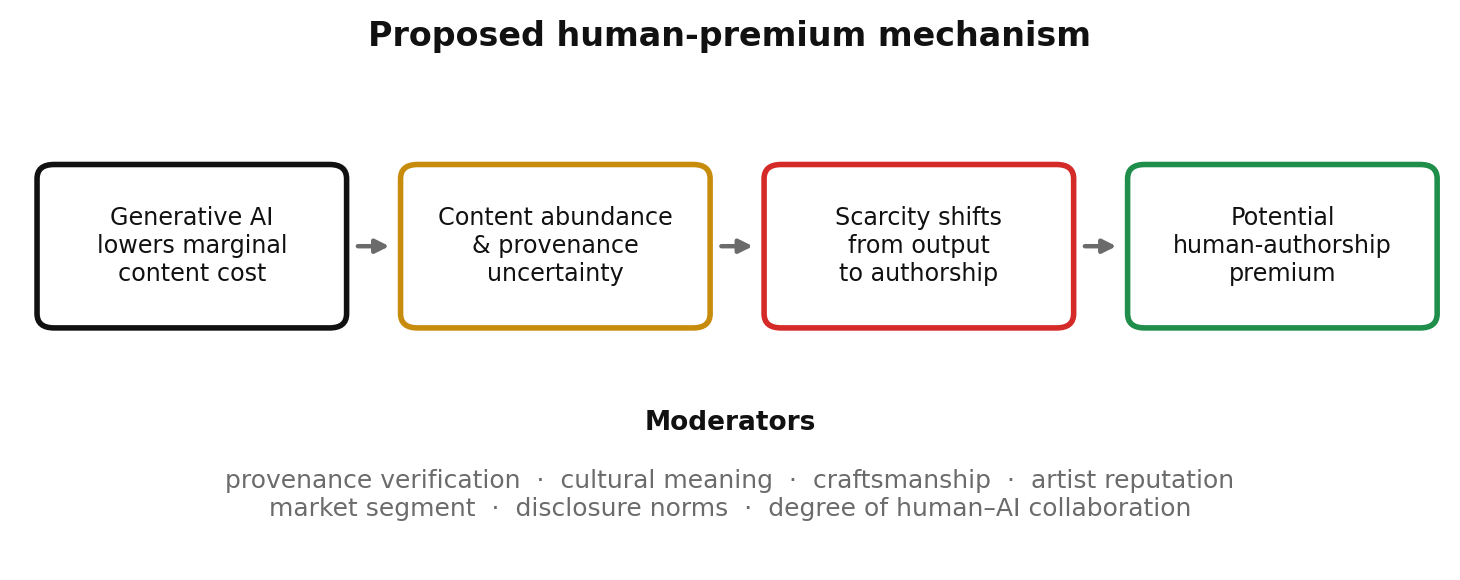
As generative AI makes competent creative output dramatically more abundant and inexpensive, scarcity is increasingly relocating from the finished image, song, or text to the provenance behind it. In markets where audiences value authorship, effort, craftsmanship, narrative, and verifiable human intention, this shift can create a human-authorship premium: a higher cultural and potentially monetary value attached to demonstrably human-made work. AI therefore need not simply destroy the value of traditional art. Under specific market conditions, its very abundance may strengthen the distinctiveness of human creative labour.
Important qualification. Current evidence strongly supports an AI-label valuation penalty and rapid growth in synthetic content, but it does not yet prove that all traditional art prices will rise because of AI. This paper treats the human-premium effect as an evidence-based market hypothesis whose strength will vary by medium, audience, provenance, and market segment.
Abstract
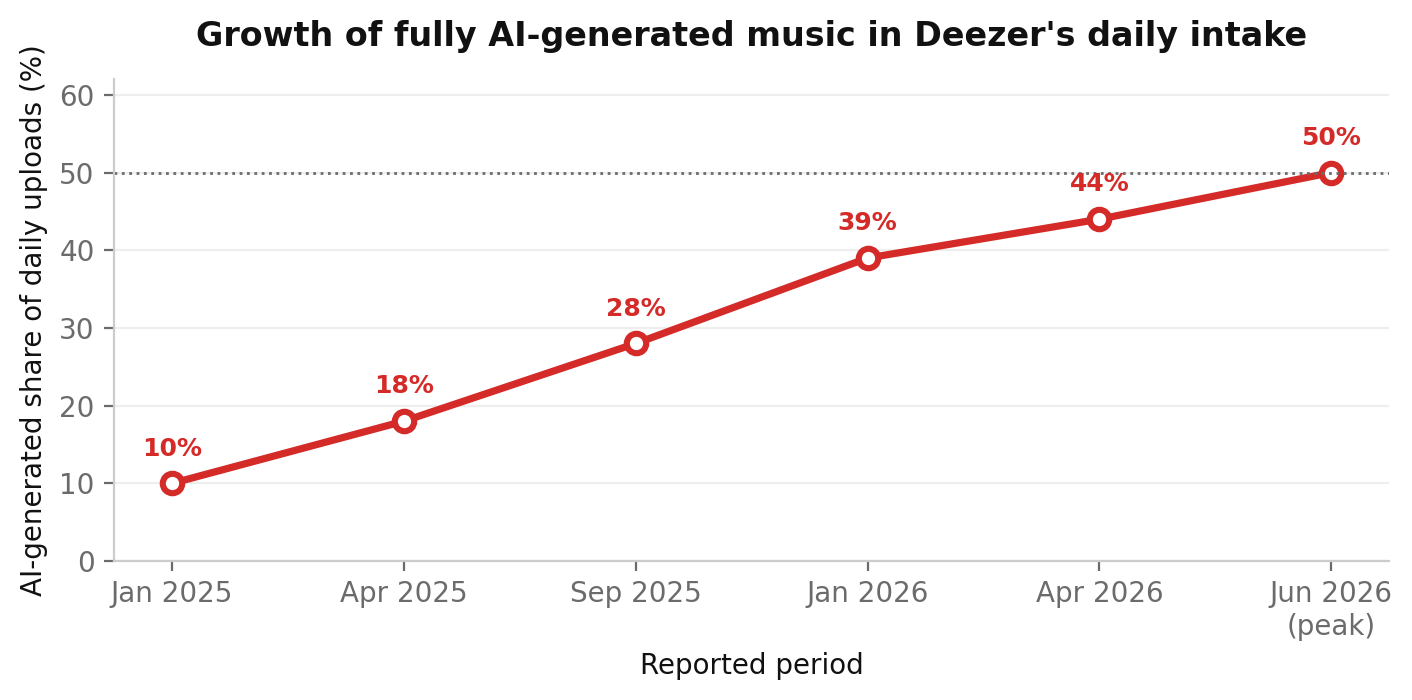
Generative artificial intelligence has altered the economics of creative production by reducing the time and marginal cost required to produce images, music, text, video, and design variations. The most common interpretation is that this abundance threatens artists by increasing supply and depressing prices. This paper develops a complementary argument: the same abundance can make verifiable human authorship comparatively scarce and therefore more meaningful. Evidence from experimental aesthetics shows that identical or comparable works are often assigned lower monetary value, skill, and production effort when observers believe they were made by AI. At the same time, platform data show a rapid expansion of fully synthetic content: Deezer reported that AI-generated tracks rose from roughly 10% of daily deliveries in January 2025 to more than 50% at peak in June 2026, while Adobe reports tens of billions of Firefly generations. These developments increase the importance of provenance. The paper proposes a human-premium framework in which craftsmanship, authorship, scarcity, cultural signalling, intellectual-property status, and trust become differentiating assets. It then applies that framework to a working case — a hand-drawn animation studio operating in a small, culturally specific market — and sets out a production disclosure standard that a studio can adopt directly. It also addresses counterevidence: AI content can be aesthetically competitive, some consumers respond positively to it, and human-AI collaboration complicates any simple human-versus-machine distinction. The conclusion is not that AI automatically makes traditional art more expensive, but that AI abundance creates economic conditions under which verified human creation can become a premium category.
Keywords: generative AI, traditional art, human authorship, authenticity, provenance, art market, creative economy, willingness to pay, scarcity, hand-drawn animation, Caribbean creative industries
1. Introduction: When Creation Becomes Abundant
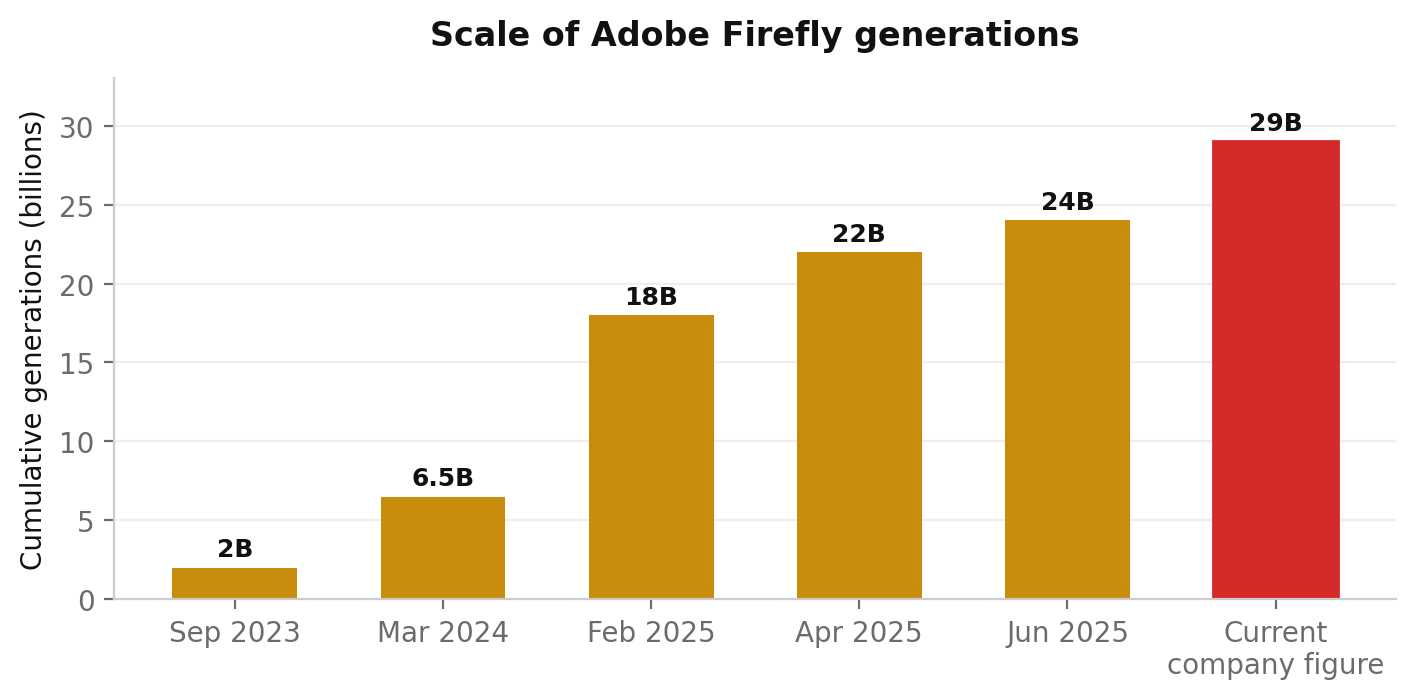
Generative AI changes creative markets primarily by changing the economics of supply. A person can now produce, revise, and multiply creative outputs at a scale that would previously have required far more labour, specialised training, or production time. Adobe reported more than 24 billion Firefly generations by June 2025 and currently reports more than 29 billion images generated with Firefly since launch (Adobe, 2025b, 2026). These figures represent only one ecosystem, but they illustrate the magnitude of the supply shock.
The same pattern is visible in music. Deezer's detection system reported that fully AI-generated tracks represented about 10% of daily deliveries in January 2025, 18% in April 2025, 28% in September 2025, 39% in January 2026, 44% in April 2026, and more than 50% at peak in June 2026 (Deezer, 2025a, 2025b, 2026a, 2026b). In its July 2026 statement the company described a June peak averaging roughly 90,000 fully AI-generated tracks per day. Importantly, volume and consumption were not equivalent: Deezer reported that fully AI-generated music still represented only 1%–3% of total streams, and that a large share of those streams was associated with fraud. The result is an increasingly crowded supply environment without corresponding evidence that audiences value synthetic output at the same rate.
The central question, then, is not simply whether AI can make art. It is what becomes scarce after competent output becomes easy to generate. Economic value often attaches not to abundance but to scarcity, differentiation, trust, and meaning. In an AI-saturated market, the scarce resource may increasingly be a credible chain of human authorship: who made the work, how it was made, what skill was embodied in it, and why that process matters.
2. From Output Scarcity to Authorship Scarcity
Traditional creative markets historically bundled the artifact and the labour behind it. A painting implied a painter; an illustration implied an illustrator; a recorded performance implied performers and a production process. Generative systems weaken that inference. A polished artifact can no longer reliably signal how much human labour, training, or intentional decision-making produced it.
This creates a provenance problem. When consumers cannot infer origin from appearance, information about origin itself becomes economically relevant. The value proposition of traditional art may therefore shift from “this image is difficult to make” to “this image is demonstrably the result of a particular person's practice, decisions, history, and embodied skill.” That is a different kind of scarcity — one AI can imitate stylistically but cannot literally duplicate as biography or human experience.
Recent research supports the importance of provenance labels. In a 2026 experiment with 618 short-form-video users, AI-generated labels significantly reduced perceived creator effort, while human-made labels were not significantly different from unlabelled content, suggesting that users may still treat human authorship as the default unless told otherwise (Human-made vs. AI-generated, 2026). The asymmetry matters, and it cuts in a specific direction: disclosure of machine origin changes the perceived meaning of an otherwise similar artifact, while disclosure of human origin mostly confirms what audiences already assumed. As that default assumption erodes, the human label stops being redundant and starts carrying information.
3. The AI-Label Penalty and the Human-Creativity Contrast Effect
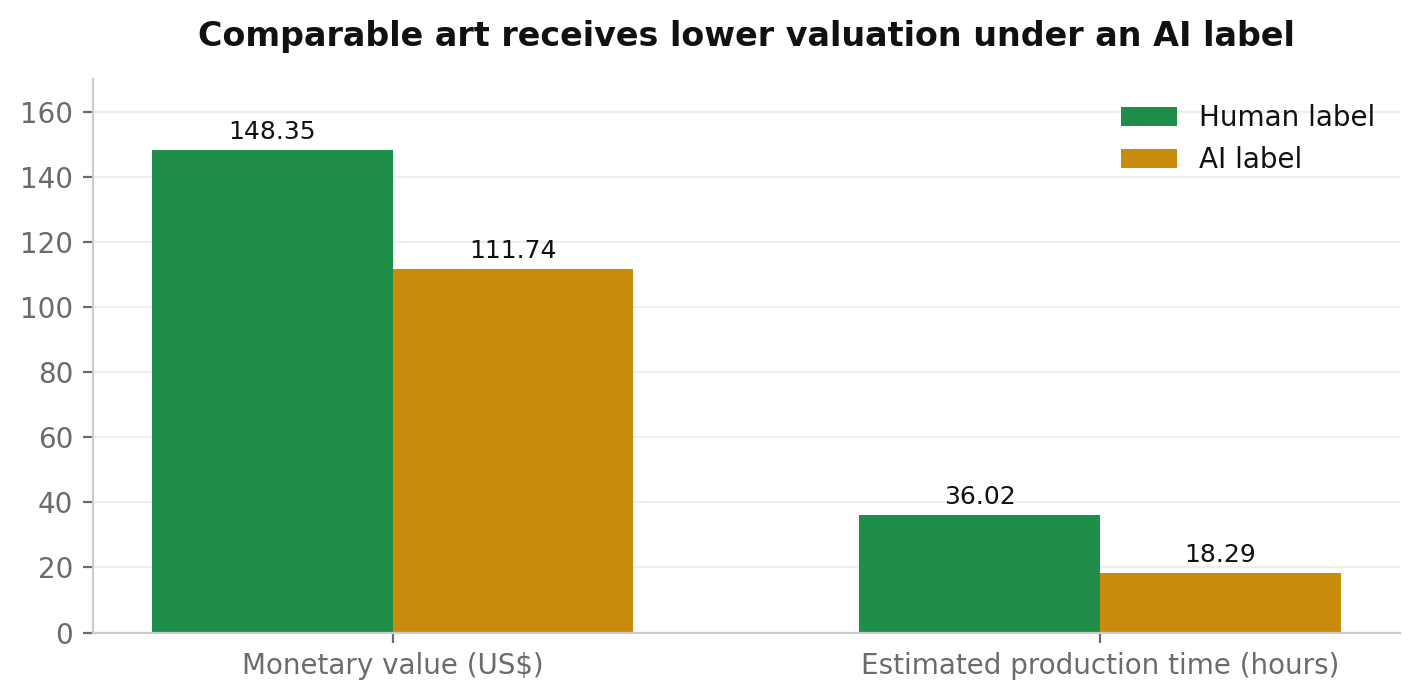
Experimental research provides some of the strongest evidence for a human-authorship premium. Bellaiche and colleagues (2023) conducted six experiments examining how people evaluated art attributed to humans versus AI. Across experiments, merely believing that art was AI-made reduced appraisals even when content was held constant or controlled. The effect was especially pronounced for perceived skill and monetary value.
In one reported condition, a painting labelled as human-made received a mean monetary valuation of $148.35 and an estimated production time of 36.02 hours, compared with $111.74 and 18.29 hours when the comparison painting carried an AI label. The authors' broader experiments also found cases in which AI labels produced a 62% decrease in estimated monetary value and a 77% decrease in estimated production time relative to human-attributed work (Bellaiche et al., 2023). These results do not establish real auction prices, but they demonstrate a causal psychological mechanism: attribution changes valuation.
Even more relevant to the present thesis, the researchers found a contrast effect in which human-labelled work could be evaluated as more creative after exposure to AI-labelled work. In other words, AI did not merely receive a penalty; its presence sometimes enhanced perceptions of human creativity. This is precisely the mechanism through which market saturation could make human provenance more salient. It also implies something counter-intuitive for creators: the growth of synthetic content is not purely a threat to the perceived value of human work, because the comparison itself is part of what makes human work legible.
4. The Scale of Synthetic Abundance
The human-premium thesis depends on AI content becoming sufficiently abundant that origin becomes a meaningful differentiator. Available platform evidence indicates that this condition is emerging rapidly. Adobe's Firefly totals grew from more than 2 billion generations in September 2023 to 6.5 billion images by March 2024, more than 18 billion assets by February 2025, more than 22 billion by April 2025, and more than 24 billion by June 2025 (Adobe, 2023, 2024, 2025a, 2025b). Adobe's corporate information now cites more than 29 billion Firefly images generated since launch (Adobe, 2026).
Music provides an unusually measurable case because Deezer has published a time series from its AI-detection system. The share of fully AI-generated daily deliveries rose several-fold in approximately eighteen months. By June 2026, peak daily intake had crossed the 50% threshold. This does not mean half of music consumption is AI-generated; it means the supply entering the platform has changed dramatically. Such a gap between supply and actual listening is economically important because it suggests that generating inventory is easier than generating attention, trust, fandom, or cultural attachment.
AI therefore intensifies a long-standing creative-economy problem: abundance of content and scarcity of attention. The strategic response for human creators is not to compete with machines on raw volume. It is to compete on the dimensions for which volume is a poor substitute — authorship, reputation, cultural specificity, live presence, craftsmanship, community, narrative continuity, and proof of process.
5. Traditional Art as a Premium Category
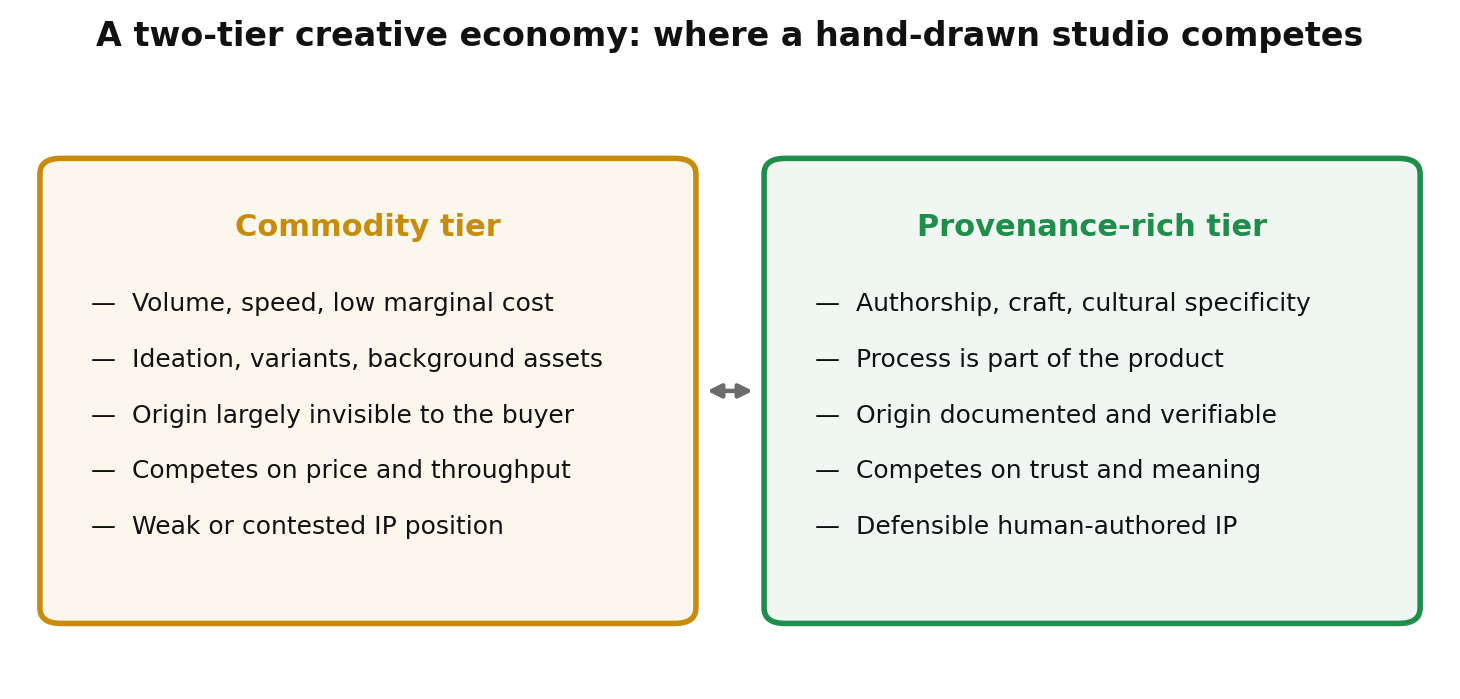
The strongest version of the argument is not that every handmade object becomes expensive. Scarcity creates value only when buyers care about what is scarce. A hand-drawn sketch by an unknown artist is not automatically valuable simply because it is human-made. A human premium becomes plausible when provenance combines with other value-producing factors: recognised skill, distinctive style, cultural meaning, limited supply, reputation, collectability, and credible documentation.
This suggests a two-tier creative economy. High-volume synthetic content can dominate low-cost ideation, personalisation, background assets, commodity imagery, and rapid iteration. At the same time, human-made or human-led work can occupy a premium tier where the process is part of the product. The analogy is not “AI art versus real art” but mass production versus provenance-rich production. Photography did not eliminate painting; recorded music did not eliminate live performance; industrial manufacturing did not eliminate handmade luxury goods. New production technologies frequently reorganise value rather than erase older forms.
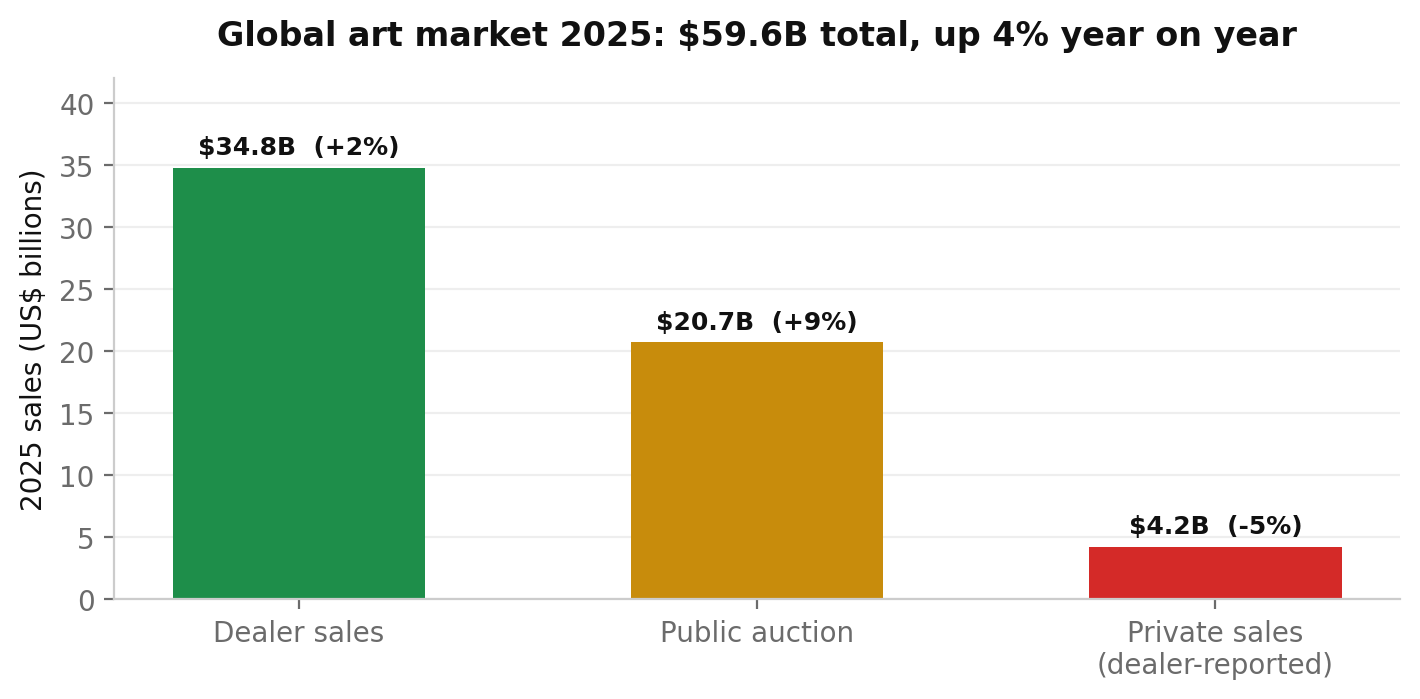
The 2026 Art Basel and UBS Global Art Market Report provides useful context. Global art-market sales rose 4% in 2025 to an estimated $59.6 billion after two years of decline. Dealer sales rose 2% to $34.8 billion and public-auction sales rose 9% to $20.7 billion, while reported private sales fell 5% to just under $4.2 billion (McAndrew, 2026). This recovery cannot be attributed to AI and should not be presented as evidence that AI is raising traditional-art prices. It does, however, demonstrate that a market centred on provenance, artists, objects, galleries, and auctions remains economically substantial while generative media expands — and that the recovery was led by the segment with the most public, most documented provenance chain.
6. Authenticity, Trust, and Cultural Signalling
Authenticity is partly a property of the work and partly a relationship between the audience and the creator. In markets saturated with synthetic media, knowing that a person actually performed, painted, drew, sculpted, animated, photographed, or wrote a work can itself become meaningful information. The consumer is not only buying pixels, pigment, sound, or words; the consumer may be buying connection to an identifiable human practice.
This is also a signalling function. Supporting a human artist can communicate taste, patronage, cultural affiliation, ethical preference, or resistance to disposable content. The more difficult it becomes to distinguish synthetic from human media by appearance alone, the more valuable credible provenance systems may become. Signatures, process footage, sketches, source files, certificates, studio documentation, live demonstrations, edition records, and content credentials can all operate as trust infrastructure.
Transparency is becoming institutionally relevant as well. Adobe attaches Content Credentials to Firefly-generated assets, and the U.S. Copyright Office has reaffirmed that copyright protection in the United States depends on sufficient human authorship; purely AI-generated material is not protected merely because a person supplied prompts, although AI-assisted works can contain protectable human expression (U.S. Copyright Office, 2025). Legal rules and provenance technologies therefore reinforce the economic distinction between automated output and human-authored expression. For a studio, this is not an abstract point: the human-authored portion of a production is the portion that can be owned, licensed, and defended.
7. Why AI Can Support Rather Than Destroy the Art Industry
The argument that AI can support the art industry should not be confused with the claim that AI causes no harm. Generative systems raise serious issues involving training data, labour displacement, fraud, impersonation, attribution, bargaining power, and compensation. Those problems are real. The narrower claim developed here is that technological substitution and value creation can occur simultaneously in different segments of the same market.
AI can lower the cost of ideation, references, administrative work, variation, accessibility, translation, previsualisation, and repetitive production tasks. Used as an assistive instrument under human direction, it can increase the amount of time artists spend on high-value creative judgement. The U.S. Copyright Office's position is consistent with this distinction: the use of AI as an assisting tool does not itself prevent copyright protection for the human-authored portions of a work (U.S. Copyright Office, 2025).
At the market level, AI may also make the public more conscious of labour that was previously invisible. Once audiences know that a polished image might have been generated in seconds, the fact that another image required years of training and days or weeks of deliberate work can become more salient. Technology can therefore create a contrast that strengthens appreciation for process — provided creators communicate that process effectively.
8. Counterarguments and Limits
A credible analysis must resist technological romanticism in both directions. First, AI-generated work can be aesthetically successful. Some studies have found contexts in which non-experts show little bias against AI paintings (Gu & Li, 2022). Visual quality alone is therefore not a reliable basis for a human premium.
Second, disclosure effects are context-sensitive. Jin and Tao (2025) found that even the wording used to frame AI visuals — “created” rather than “generated” — can influence willingness to pay through perceived product value. Human-AI collaboration further complicates categorical labels. A film, game, illustration, or advertisement may include human direction, AI-assisted ideation, procedural tools, and traditional craft simultaneously.
Third, the empirical literature mostly measures perception, stated willingness to pay, or experimental valuation rather than long-run market prices. There is not yet sufficient longitudinal evidence to claim that generative-AI saturation has caused a broad increase in prices for traditional art. The defensible conclusion is conditional: AI abundance increases the potential premium on verified human authorship where consumers value provenance and where creators can credibly signal it.
Fourth, a premium category invites counterfeit claims. If “human-made” becomes commercially valuable, some producers will assert it without basis. Any premium built on provenance therefore depends on verification being cheap for honest producers and difficult for dishonest ones — a condition that does not yet reliably hold across creative markets.
9. Case Application: A Hand-Drawn Studio in a Small Market
The preceding sections describe a market condition. This section applies it to a working case: Wave Animation Ltd., a hand-drawn 2D studio based in Kingston, Jamaica, currently in development on the animated feature Blackgoats. The purpose is not promotional. It is to test whether the framework produces operational decisions rather than sentiment, and to state plainly where it does not.
9.1 Cultural specificity is the hardest input to synthesise
Style is imitable. A model can approximate a line quality, a palette, a rhythm of movement. Biography and cultural position are a different category. Blackgoats is drawn from the Manja story universe — Jamaican folklore, language, landscape, and performance — and it is made by Jamaican artists working in Jamaica. Generative systems reproduce patterns weighted toward the corpora they were trained on, which are dominated by globally over-represented visual and narrative traditions. A small, specific, historically under-represented culture is close to the opposite of that average.
This yields two distinct scarcities rather than one. The work is scarce as content, because comparatively little of it exists. It is also scarce as provenance, because the claim “made here, by these people, from this tradition” is verifiable in a way that a stylistic imitation is not. Section 5's premium condition — provenance combined with cultural meaning, distinctive style, and limited supply — is unusually well satisfied by culturally specific work from a small market.
9.2 Proof of process should be a by-product of the pipeline, not a marketing exercise
Most studios document their process after the fact, reconstructing behind-the-scenes material once a film is finished. That is expensive, incomplete, and weakly evidential. The alternative is to capture authorship while the work happens. Wave's eight-stage hybrid pipeline and the Wave Connect Board already generate an authorship record as a normal condition of production: shot-level assignment, revision history, and a trace of which artist completed which stage. TaskPay ties compensation to that same record.
The strategic observation is that a production-management system that knows who did what is, incidentally, a provenance ledger. The cost of credible provenance is close to zero when it is captured during production and close to prohibitive when it is reconstructed afterwards. If human authorship is becoming a priced asset, then production tooling is not only an efficiency investment — it is the mechanism that makes the asset provable.
9.3 Craft training is premium infrastructure, not nostalgia
If verified human authorship is the scarce input, then the capacity to produce trained human artists is upstream of the premium itself. Wave Academy and the studio's internship programme — spanning pre-production, live-action production, 2D production, 3D production, editorial and post, and marketing/technology — are best understood in those terms rather than as corporate social responsibility. A studio that trains animators owns part of the supply of the scarce input; a region that trains animators owns part of the supply for every studio in it.
This is also why Wave's position on training is deliberately non-rivalrous. In a market the size of Jamaica's, the binding constraint is not competition between studios for a fixed pool of skilled artists. It is the size of the pool. Shared training capacity raises the ceiling for the whole sector, and a sector with credible craft depth is a more convincing provenance claim than any single studio can make alone.
9.4 Policy implications for Jamaica
Two implications follow for the National Animation Policy consultation and for sector planning more broadly. First, intellectual-property retention by Jamaican creators is a provenance question as much as an equity question. Because copyright protection depends on sufficient human authorship (U.S. Copyright Office, 2025), human-authored Jamaican IP sits precisely in the category that remains protectable while purely generated material does not. Policy that helps local creators retain ownership is protecting an asset whose relative scarcity is increasing.
Second, shared digital infrastructure for the sector should treat provenance and credentialing capability as standard rather than optional. Verification is a fixed cost that a small studio struggles to carry alone and that a sector can carry together. Building it into shared infrastructure would let Jamaican productions make disclosure claims that hold up to scrutiny in international markets, which is where the premium, if it materialises, will be paid.
9.5 What this case does not claim
Honesty about the limits is what makes the rest usable. Nothing in the evidence reviewed here establishes that a hand-drawn feature automatically earns a premium from a distributor, a streamer, or a box office. Hand-drawn production remains slower and more costly per finished minute, and provenance does not by itself pay for that difference. The literature measures perceptions and stated valuations, not licensing outcomes for animated features.
The defensible claim is narrower and still worth acting on. In a market where synthetic supply is rising quickly, a specific, documented, human-authored film holds a differentiation asset that a synthetic competitor cannot purchase. The studio's task is to make that asset visible and verifiable rather than to assume audiences will infer it. The rest of this paper's recommendations follow from that task.
10. Strategic Implications for Artists, Studios, Galleries, and Platforms
For creators, the strategic mistake would be to hide the human process while competing directly with AI on speed and volume. A stronger approach is to make authorship visible. Process documentation, studio diaries, rough work, live sessions, signed editions, production breakdowns, and clear statements about tool use convert provenance into part of the audience experience.
For studios, the valuable distinction is likely to be between AI replacement and AI assistance. A studio can use automation for low-value friction while preserving identifiable human creative authority over story, design, performance, direction, and final artistic decisions. This creates a marketable production standard rather than an anti-technology posture.
For galleries, marketplaces, streaming services, and creative platforms, provenance should become structured metadata rather than a vague marketing claim. Categories such as human-made, human-led with AI assistance, and substantially AI-generated can help audiences make informed choices. Verification will matter, because a premium category attracts counterfeit claims.
For educators and policymakers, the implication is that craft education remains economically relevant. If human authorship becomes a premium signal, training in drawing, animation, music, writing, performance, design, and material practice is not obsolete. It becomes part of the infrastructure that produces scarce, differentiated creative labour.
10.1 A production disclosure standard a studio can adopt
The categories above are only useful if they are operationalised. The table below sets out a three-tier disclosure standard at the level of detail a production can actually apply, using Wave's pipeline as the worked example. The tiers describe where the work sits, not how good it is.
Tier | Definition | Evidence required | Application in a Wave production |
|---|---|---|---|
Human-made | All creative decisions and all delivered imagery produced by named human artists. No generative imagery appears in the delivered frame. | Named artist credit at shot level; drawn revision history retained; source files archived. | Character animation, key art, backgrounds, final delivered frames. |
Human-led, AI-assisted | Human authorship over story, design, performance and final judgement. Generative tools used only for non-delivered support work. | Tool use logged at pipeline stage; a plain statement of what the tool did and what it did not touch. | Previsualisation, reference boards, variation studies, scheduling and administrative work. |
Substantially AI-generated | Delivered material substantially machine-produced under prompt direction, with limited human authorship in the output itself. | Explicit label; excluded from any human-authorship or copyright claim made for the production. | Not used in delivered Blackgoats material. |
11. Conclusion
Generative AI is often described as a force that will devalue creative work because it can produce enormous quantities of content at low marginal cost. That analysis is incomplete. When output becomes abundant, markets search for new dimensions of scarcity. In creative industries, one of those dimensions is likely to be provenance: the credible presence of human authorship, effort, skill, intention, and cultural experience.
Current evidence already shows the components of this shift. Synthetic supply is expanding rapidly. Experimental participants often assign lower monetary value and effort to work labelled as AI-made. Human creativity can become more salient by contrast. Legal and technical systems are increasingly distinguishing human authorship from machine generation. Meanwhile, established art markets remain substantial and continue to trade on artist identity, scarcity, provenance, and cultural meaning.
The likely future is therefore not a simple contest in which AI eliminates traditional art. It is a stratified creative economy. Generative media will make some forms of content cheaper and more plentiful, while verified human creation can become more distinctive. AI's greatest economic effect on traditional art may ultimately be paradoxical: by making images, sounds, and words easier to manufacture, it can make authentic human authorship harder to substitute — and therefore more valuable.
For a studio drawing frames by hand in a small market, the practical conclusion is unglamorous. The premium, if it arrives, will not be paid for being human. It will be paid for being human and being able to prove it. Build the proof into the pipeline, train the people who make the work, and keep the culture in the frame specific enough that no average can reproduce it.
Figure and Table Index
Figure | Title | Primary data / source |
|---|---|---|
1 | Growth of fully AI-generated music in Deezer's daily intake | Deezer platform reports, 2025–2026 |
2 | AI-label effect on monetary value and estimated production time | Bellaiche et al. (2023), Experiment 4 |
3 | Scale of Adobe Firefly generations | Adobe corporate and newsroom reports, 2023–2026 |
4 | Global art-market sales by segment, 2025 | Art Basel & UBS / Arts Economics (McAndrew, 2026) |
5 | Proposed human-premium mechanism | Author synthesis of cited evidence |
6 | Two-tier creative economy | Author synthesis of cited evidence |
Table 1 | Proposed production disclosure standard | Author synthesis; Wave Animation pipeline |
References
Adobe. (2023, September 13). Adobe unleashes new era of creativity for all with the commercial release of generative AI. Adobe Newsroom. https://news.adobe.com/news/news-details/2023/adobe-unleashes-new-era-of-creativity-for-all-with-the-commercial-release-of-generative-ai
Adobe. (2024, March 26). Firefly at one: Enhancing experimentation, ideation, and exploration for creators of all levels. Adobe Blog. https://blog.adobe.com/en/publish/2024/03/26/uk-firefly-one-enhancing-experimentation-ideation-exploration-creators-all-levels-k
Adobe. (2025a, April 24). Adobe Firefly: The next evolution of creative AI is here. Adobe Blog. https://blog.adobe.com/en/publish/2025/04/24/adobe-firefly-next-evolution-creative-ai-is-here
Adobe. (2025b, June 17). Adobe Firefly revolutionizes creative ideation with new mobile app, multimedia moodboarding and expanded AI models. Adobe Newsroom. https://news.adobe.com/news/2025/06/adobe-firefly-revolutionizes-creative-ideation-new-mobile-app
Adobe. (2026). About Adobe. https://www.adobe.com/about-adobe.html
Bellaiche, L., Shahi, R., Turpin, M. H., Ragnhildstveit, A., Sprockett, S., Barr, N., Christensen, A., & Seli, P. (2023). Bias against AI art can enhance perceptions of human creativity. Scientific Reports, 13, 19001. https://doi.org/10.1038/s41598-023-45202-3
Deezer. (2025a, January 24). Deezer deploys cutting-edge AI detection tool for music streaming. Deezer Newsroom. https://newsroom-deezer.com/2025/01/deezer-deploys-cutting-edge-ai-detection-tool-for-music-streaming/
Deezer. (2025b, September 11). Deezer: 28% of all music delivered to streaming is now fully AI-generated. Deezer Newsroom. https://newsroom-deezer.com/2025/09/28-fully-ai-generated-music/
Deezer. (2026a, January 29). Deezer confirms demonetization of up to 85% of AI-music streams due to fraud and moves to sell AI-detection technology. Deezer Newsroom. https://newsroom-deezer.com/2026/01/deezer-confirms-demonetization-of-ai-music/
Deezer. (2026b, July 21). Deezer: AI music has surpassed 50% of new music uploads for the first time. Deezer Newsroom. https://newsroom-deezer.com/2026/07/ai-music-exceeds-50-percent-daily-uploads-deezer/
Gu, L., & Li, Y. (2022). Who made the paintings: Artists or artificial intelligence? The effects of identity on liking and purchase intention. Frontiers in Psychology, 13, 941163. https://doi.org/10.3389/fpsyg.2022.941163
Human-made vs. AI-generated: How provenance labels drive strategic curation via perceived effort. (2026). Frontiers in Psychology. https://doi.org/10.3389/fpsyg.2026.1840483
Jin, Z., & Tao, X. (2025). Framing the future: How AI's creation versus generation visuals affects consumer willingness to pay. Psychology & Marketing, 42(10), 2496–2508. https://doi.org/10.1002/mar.22242
McAndrew, C. (2025). The Art Basel and UBS global art market report 2025. Arts Economics / Art Basel & UBS.
McAndrew, C. (2026). The Art Basel and UBS global art market report 2026. Arts Economics / Art Basel & UBS. https://theartmarket.artbasel.com/
U.S. Copyright Office. (2025, January 29). Copyright and artificial intelligence, Part 2: Copyrightability. https://www.copyright.gov/ai/
Source and Data Notes
Scope. This paper uses a mixture of peer-reviewed experimental research, official platform disclosures, a major art-market report, and U.S. copyright guidance. Platform statistics are useful for measuring scale but are self-reported and should not be treated as independent market audits.
Causality. No cited source demonstrates that the growth of generative AI has directly caused an increase in traditional-art prices. The paper's principal contribution is a synthesis: rapid synthetic abundance plus experimentally observed provenance effects creates a plausible mechanism for a human-authorship premium.
Terminology. “Traditional art” is used broadly to refer to work whose market proposition materially depends on identifiable human authorship, craft, and creative decision-making. It is not limited to non-digital media. A digitally drawn animation frame can be human-made; a physical print can be substantially AI-generated.
Chart construction. Figures 1, 2 and 4 plot values reported directly in the cited sources. Figure 3 compiles Adobe's cumulative milestones across different reporting dates. Figures 5 and 6 are conceptual and contain no measured values. Table 1 is a proposed standard, not an observed practice.
Verification. Deezer's June 2026 peak figure and the 2026 Art Basel and UBS segment values were re-checked against the primary releases in September 2026. The Frontiers in Psychology (2026) provenance-label study is listed by title because complete author metadata was not available at the time of writing; author details should be confirmed from the journal database before formal submission.
APA note. References are formatted in APA 7 style as closely as possible from publicly available source metadata. For formal academic submission, journal database metadata should be cross-checked for complete author lists, issue numbers, and page ranges where required.
© 2026 Wave Animation Ltd., Kingston, Jamaica. Published for open circulation within Jamaica's animation and creative sector.